Curating reads
Gathering fresh stories and ideas for you
Curating reads
Gathering fresh stories and ideas for you
Curating reads
Gathering fresh stories and ideas for you
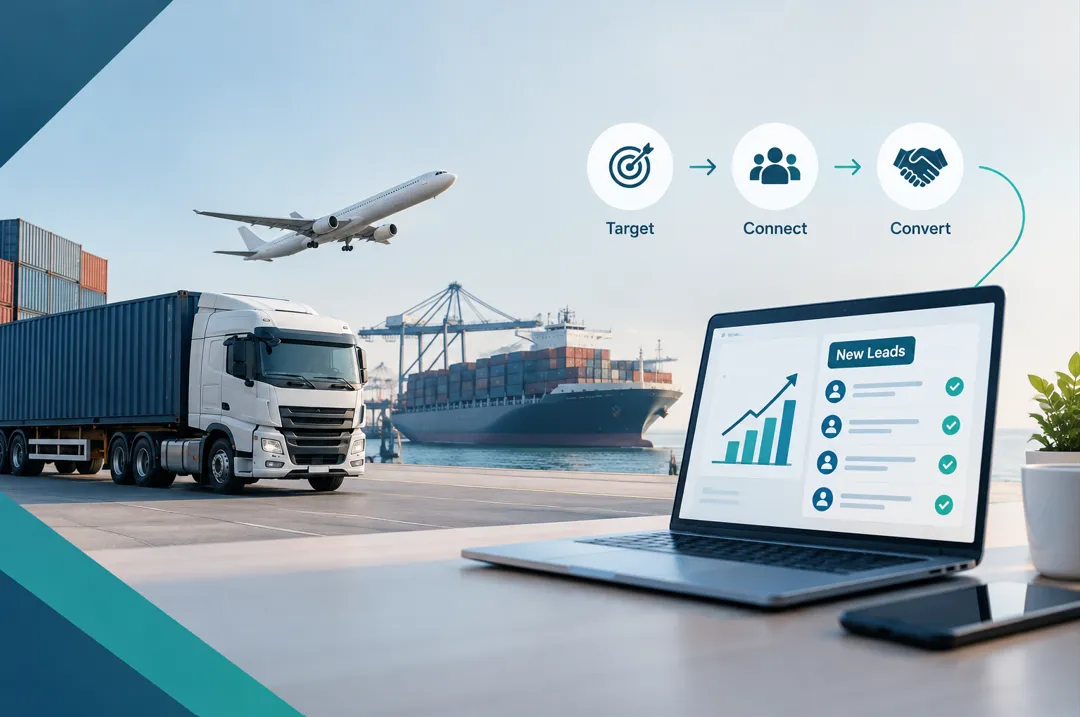

Buyers, most of the time, don’t wake up and change carrier. They change because a shipment was late, a rate increased, a broker stopped returning calls, or their volume has surpassed current capacity. When that moment comes, the buyer researches, inquires within their network, and evaluates the limited set of companies that are top of mind. The company already on that list wins the first sale.
That’s what B2B lead generation is all about in this space. The sales cycle is lengthy, multiple decision-makers are often involved, and trust is more important than a cool ad. When a shipper gives you their freight, they’re giving you a piece of their reputation with their customers.
Here’s a step-by-step guide to help logistics and freight companies generate a consistent stream of qualified B2B leads. It explores who you’re really marketing to, which paths to get there, how to track your progress and what determines a buyer’s decision to pick up the phone or not. As we go, it demonstrates how digital marketing for logistics can nourish the relationships that power your business.
Looking for a Logistics Lead Generation Partner?
Build a consistent pipeline of qualified freight leads and connect with the shippers who need your services.
Explore Logistics Marketing ServicesFreight services aren’t like selling a consumer product, and there are a few things about this industry that define what marketing should look like.
Buying groups are bigger than one person. A logistics manager might jump in to start the process, but then procurement, finance and operations may join the conversation, each with different concerns such as rates, capacity, billing accuracy, transparency. And, of course, there’s the risk of choosing a new provider. If that provider doesn’t deliver, the buyer bears the costs of late shipments, unhappy customers and difficult discussions.
Timing, too, is uncertain. One month a shipper may not require a new carrier at all, then suddenly by Friday they do, and you want your marketing to do the heavy lifting during your downtime so that you’re the first thing they think of when they’re ready to buy.
There’s still power in a network. Endorsements, repeat business, referral, and having a personal connection are still key, and digital marketing for logistics companies shouldn’t try to push them aside.
Therefore the aim of online marketing is not to turn the sale over rapidly. But to be visible, to appear professional and to make it simple for a prospective customer to start a dialogue.
Lead generation fails with a fuzzy target. “Anyone who ships freight” is not a target. The more specific you can be in what type of businesses, or people, constitute your perfect customer the more you can focus on the right channels, create relevant content and evaluate the quality of a lead.
Begin with the fundamentals: The types of customers that you know best, the shipment sizes and vehicle types that you manage comfortably, the directions and markets where you have a presence, and the size of the business that corresponds to your talent. Each type of carrier is going to desire unique customers.
Next, consider who is inside those companies.
| Role | Their priorities | What do you want to exhibit to them? |
|---|---|---|
| Transport or logistics supervisor | Timely delivery, communication, tracking | Service information Performance reports Easy to find contact details |
| Lead for procurement / buying | Price, contract conditions, risk | Clear pricing method, referrals, insurance |
| Supply chain / operations director | Capacity, adaptability, long-term suitability | Case studies, network coverage, technology and reporting |
| Finance contact | Billing precision, payment terms | Transparent invoicing procedure and documents |
| Owner or executive of a small shipper. | Dependability and trust | Open access to leadership, straightforward answers |
Allow this table to be a source of inspiration for your website copy, your emails, and yes, even the questions asked of your sales team. the first call.
Think of the channels below as parts of one system rather than separate tactics. The website earns trust, search and outreach bring people in, content and email keep them warm, and partnerships back it all up. Each piece makes the others work better.
Your website is the place where a buyer gets the first impression and in most cases, they get the worst impression. An overgrown services page and a bland “contact us” button does not help a person considering 5 carriers.
Features of a good logistics website:
Speed and mobile design are also key. Dispatchers and logistics managers may glance at their phones between calls.
Search is one of the few channels that connects with buyers when they are actively looking. People enter specific queries, like “temperature-controlled freight services Midwest,” “3PL for e-commerce brands,” or “LTL carrier Charlotte to Atlanta.” Pages that match these searches can attract leads who are already near a decision.
Approach search from multiple perspectives. Create service and industry pages focused on actual search terms. Add lane or regional pages only where you have true expertise and specific information to provide. Ensure each office or warehouse has an up-to-date Google Business Profile. Publish guides that address questions buyers typically have before making a decision.
Search requires patience and diligence, which many freight companies simply don’t have time for. This is one of the reasons some hire outside expertise – and digital marketing for logistics companies is a specialized field where a team who understands the search habits and long buying cycles of this industry can go a long way toward avoiding wasted effort.
If you’re selling B2B logistics, LinkedIn may be the most valuable social site because you can search for people by job title, company size and industry. Here’s how it works.
A constant company and leadership presence helps. Engagement on operational activities, industry updates, safety initiatives, team success, and customer wins demonstrates that there are real people behind the keyboard.
Second, you can also begin conversations with the right people through direct outreach. A straightforward, courteous thread usually does the trick:
Mass messages just get deleted, very few get answered. A message that demonstrates you’ve visited their business often does.
Paid ads help you catch up while you wait for your search rankings to catch up, and they allow you to target very precise audiences with ease. Examples of high, purchase-ready search terms include “freight brokerage services” or “drayage services near me.” Use location targeting based on your real service area, and include negative keywords to eliminate searches for jobs, driver training and free tools.
LinkedIn ads are ideal if you want to target by job title, industry and company size – good if your account-based approach is targeting a known list of shippers. You’ll pay more per click than most search ads, so they’re good if a single customer is highly valuable. Direct each ad to a page with that message, and monitor the conversions – clicks not leads.
Buyers seek reassurance that you understand their reality. A page that provides that assurance without a sales pitch is good content. Good topics are those the sales team fields repeatedly and include answers for accessorial chargeings, peak season capacity planning, documentation required for cross-border shipments or comparison of LTL vs. full truckload.
Case studies are especially important in our business. A brief story of the shipper’s need, what you did to help and what happened provides your prospects with a concrete picture. With your client’s approval, give real figures and client name. When client name cannot be revealed, describe the scenario clearly.
Many leads take a few contacts before they are ready to buy since logistics sales cycles are long. A short email sequence can stay front and center without annoying leads. Send a helpful download, an update on your service or seasonal capacity every few weeks. Divide your list into lanes or industries.
Capture this information with a CRM so it doesn’t slip through the cracks. Who had a question, when they would need service, and who on your team is responsible for following up. This is one of the most common – and most avoidable – reasons you might lose a freight sales lead.
Some B2B lead generation is offline. Your existing customers still will refer you, you still can partner with other providers and there is nothing like being at a conference, trade show or industry association meeting. Not difficult – ask happy clients to refer you, list your memberships on your site and keep your profiles on trade directories up-to-date. When you meet someone at an event, a timely personal follow-up beats having a booth every time.
Trust is a key obstacle in logistics, so viewing your company from a buyer’s perspective is beneficial. Most shippers want to verify certain details before making contact.
They want to know you’re operating legally, insured, and have a decent safety record and certifications. They want to see that you’ve moved freight like theirs – that it’s either a type of commodity, type of equipment, or lane they recognize. They want to see evidence that you’ve moved a similar types of freight consistently – references, reviews, case studies – and that they can reach a human when something breaks.
Show visitors this info high on your page (at least on the service page and the same info on an “About us” or “Why us” page): Introduce your leadership and the team who run your operations. Include people photos and describe the way you resolve issues. This transparency fosters E-E-A-T (experience, expertise, authority, trust) that search engines and buyers want.
Pipeline isn’t just a long list of contacts. Quantify the number of connections between marketing and revenue.
| Metric | The result of this | The reason why it is important |
|---|---|---|
| Source of leads | Source of questions | Indicates which channels need more love |
| Qualified leads | Leads matching your perfect customer | Discerns between relevant questions and junk questions |
| Lead-to-quote rate | % of leads that are given a quote | Indicates the rate of initial conversation conversion |
| Quote-to-customer rate | Conversion rate of quotes to customers | Indicates your offer and selling process potency |
| Cost for each qualified lead | Spend per qualified lead | Assists you in determining feasible budgets |
| Sales cycle duration | Business signed means the time from first contact to signed business. | Assists you in planning and forecasting |
| Revenue by sales channel | Money with a known provenance | Ties marketing to outcomes |
Configure call tracking, form tracking and Google Analytics to track each enquiry to source. Analyse the numbers each month and discuss with your sales team the quality of leads, not just the quantity. If you have one channel delivering less leads but more signed contracts, it requires more of your budget.
Many stalled lead generation efforts can be traced to a few common habits. The most frequent is targeting everyone. A message intended for all shippers often resonates with none, while companies that focus on specific industries or freight types and state this clearly tend to receive better responses. Another related issue is concealing proof. Buyers look for licenses, insurance information, certifications, and examples of actual work, and if these are difficult to find, many will move on to a competitor who displays them more prominently.
Speed is a further weakness. A shipper looking for a fast response will make several enquiries simultaneously, so a quick reply within an hour makes the difference between getting the business or not. Meanwhile the long-term issue works the other way: you’re competing not against one other firm but against silence until something relevant is available.
Many teams often focus on the wrong metrics. Generating more leads that do not convert into customers wastes sales resources, so it is important to monitor lead quality and revenue, not just the number of form submissions. Additionally, a website that is outdated – with old announcements, broken links, or obsolete service information – can give visitors the impression that the business is less attentive than it claims. Conducting a brief review every quarter can identify most of these issues before they result in lost opportunities.
There is no universally best channel, but search and LinkedIn often complement each other effectively. Search targets buyers who are actively seeking a provider, while LinkedIn allows you to reach out to particular individuals at chosen companies. Referrals and partnerships frequently generate the highest-quality leads, so the most effective strategy blends online presence with genuine relationships. The ideal combination depends on your services, your customers, and the amount of time your team can dedicate to each channel.
Paid ads and outreach generate leads quickly. SEO and content can take a minimum of three to six months to consistently generate results, and in high competition industries, even longer. However, with long sales cycles in logistics, the revenue from those leads will take time to hit your bank account. Tracking quotes and leads along the way is a quick indicator of progress.
Good digital marketing for freight companies boils down to a handful of consistent practices: Clearly, precisely identify your target customer, Demonstrate integrity and reliability, Be highly visible where prospective buyers search and continuously stay in touch as they make up their minds. You don’t have to add gimmicks to be persuasive. Buyers want a trusted partner, and your marketing should reflect that straightforwardly and consistently.
Look at the fundamentals in the beginning of the month. Audit your web-site for missing proof and fuzzy services pages, build tracking to see where your leads come from, and build out one or two channels until you dominate them, and then move on to the next two. And take the numbers, learn from your sales team, and improve.
Ready to Generate More Qualified Freight Leads?
Geekonomy helps logistics and freight companies build visibility, earn buyer trust, and turn digital marketing into a stronger B2B pipeline.
Talk to Our Lead Generation TeamAbout the Author :

SEO STRATEGIST
An SEO Strategist At Geekonomy Specializing In Semantic SEO, Technical Audits, And Search-Focused Content Strategy. He Helps Businesses Across The USA, UK, And India Improve Search Rankings, Grow Organic Traffic, And Generate Qualified Leads Through Structured, Data-Driven SEO Frameworks.
His Strategies Have Helped Brands Achieve Up To 3X Organic Traffic Growth And Secure Top-Page Rankings For Competitive Keywords. At Geekonomy, Rahul Shares Actionable Insights On SEO Trends, Search Algorithms, And Performance-Driven Digital Marketing Strategies Designed For Global Markets.