Curating reads
Gathering fresh stories and ideas for you
Curating reads
Gathering fresh stories and ideas for you
Curating reads
Gathering fresh stories and ideas for you
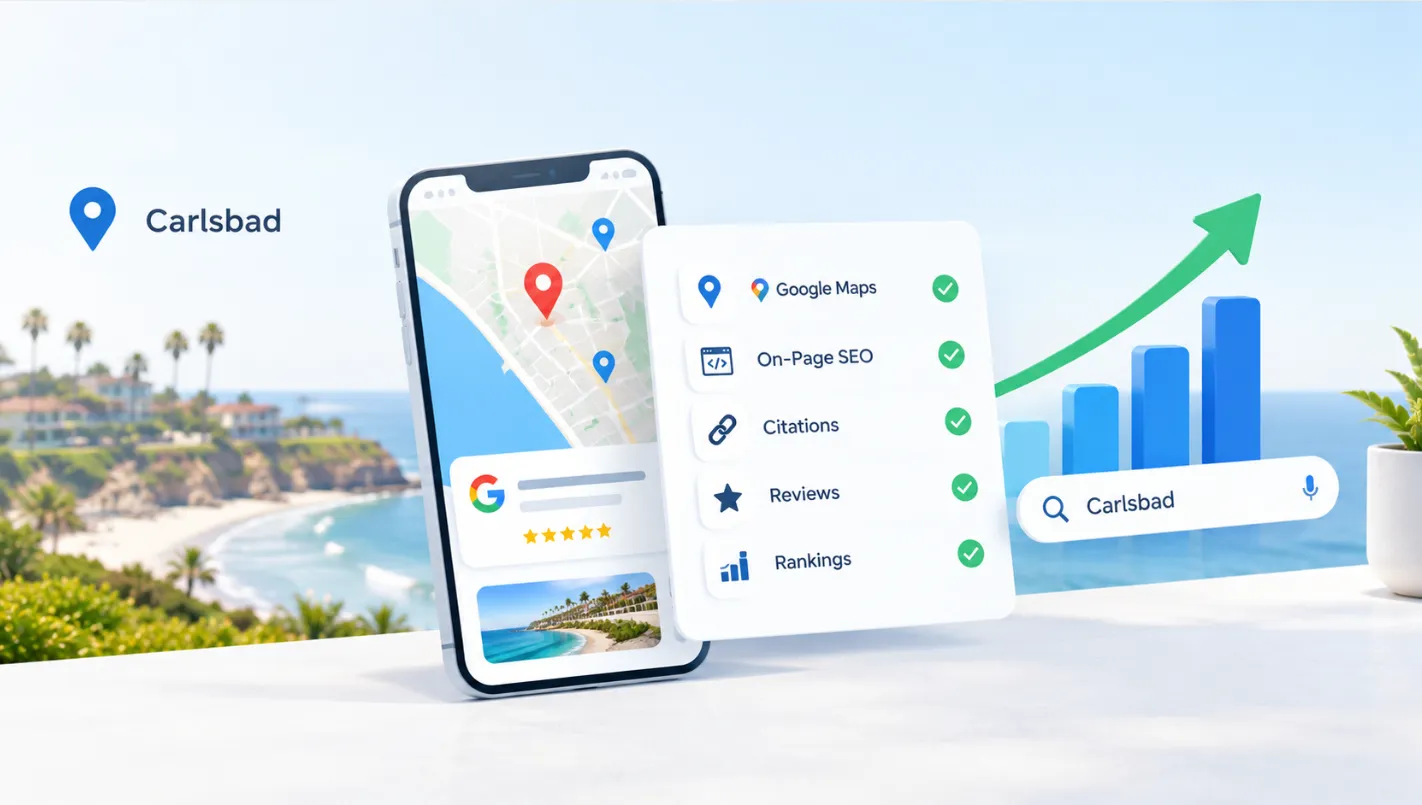

Carlsbad is a small city with a big customer base. With beach crowds in the Village, visitors coming for the Flower Fields and LEGOLAND, families in La Costa and Aviara, and offices along Palomar Airport Road, people are searching for local businesses at all hours. Whether you’re a restaurant owner, a dentist, a real estate agent, or a landscaper, you want to appear when someone nearby types what they need into Google.
The problem is that people may not be easy to find even if you’re really good at your business. Local search has its own set of rules, and a business with a stub-filled website or a Google profile that is only halfway complete can lose customers to a business that just appears more complete on the internet.
This list guides you through the work in a logical sequence, beginning with your Google Maps listing and ending with your website. You can self-audit using the list, hand it to someone on your team, or you can even have an agency do the work and then check off the steps as they are done.
Looking for a Carlsbad SEO Partner?
Dominate Google Maps, outrank local competitors, and turn nearby searchers into loyal customers with our expert Carlsbad SEO strategies.
Explore Carlsbad SEO ServicesMost of the searches with local intent like “best tacos Carlsbad Village” or “dentist near me” will send you to the map results at the top of the page. Google displays a handful of businesses in the map results, known as the local pack. Showing in that local pack can get you calls, directions and visits without anyone coming to your site.
Carlsbad throws in a few variables. Tourists and residents search differently: a visitor might Google “breakfast near Carlsbad beach,” while a resident looks for “family dentist Carlsbad” and wants someone nearby they can trust. People also search by neighborhood, such as Carlsbad Village, La Costa, Aviara or Bressi Ranch, and Google responds to that. Additionally, businesses in Oceanside, Encinitas and Vista appear for many of the same searches, so strong local signals help you stand out.
In order to get selected your page must show up in the map results and below them in the standard website results. Here’s how to get both.
Google says local results are based mainly on three factors: relevance, distance and prominence. Together they decide which businesses appear in the map results and in what order. Knowing how each one works shows you where your effort will count most.
The three factors are interconnected, and they aren’t weighted equally across every search. For example, if someone is looking for a “near me” result, then distance is weighted a lot more heavily. But if someone is searching more generally for “best wedding photographer in Carlsbad,” then prominence might weigh a lot more.
Most businesses in Carlsbad will be able to improve the two dimensions that count… relevance and prominence. Relevance Improve your profile and website content to maximize relevance, then gradually increase reviews and local mentions to improve prominence. Here are the steps to do both.
The 10 steps following your Google Maps listing down to your website, in order. Do them in order, and repeat each one every few months.
Your Google Business Profile (GBP) is the most valuable piece of local SEO real estate that you control. It determines how you are listed in both Google Maps and in the local pack. If you had to pick only one item from this article to do, this should be it.
Claim and verify your profile first. Also, an unverified listing cannot be optimized properly. Keep your business name exactly as it appears on your signs and your paperwork as your real business name. Stuffing more keywords into your name may seem like a smart idea, but your profile could get suspended.
The main category is one of your most powerful indicators so pick the one that is the primary description of what you do, then pick subcategories for the rest. Then put in the details: your address, phone number, website, hours and holidays should all be accurate and reflect your website. If you visit customers, list only the areas you visit and do not list cities you never go to.
Include short, simple descriptions of each of your services and products, and post genuine photos of your storefront, team, and completed projects. New photos let visitors know you’re still here. Posting a new offer or update every few weeks is even better. Once a month is plenty for a quick review to see if hours changed or if Google added a new category.
Reviews affect rankings and buying decisions. People read them. If someone has plenty of recent, detailed reviews, that inspires confidence in choosing your business.
A simple routine is more effective than a big effort once a year. Ask each happy customer, preferably on the same day or next day, and include a link in a text or email for leaving a review – clicking on it should only take a couple of seconds. Respond to every review in a polite, measured and detailed way whether it is negative or positive. Avoid paying for reviews or creating your own. Google considers this spam and will take reviews down.
A quick, well-considered response to a complaint may do more to heal than to harm. Say you’re sorry, tell them what you’ll do to fix the issue, and invite them to continue the conversation elsewhere. Other potential clients also read these responses and they reveal more about your business than the stars.
Google places more trust in your business info on the net. When your business’ name, address, and phone number are consistent and uniform across the internet, Google sees it as more credible.
Prioritize visiting these:
Difference in details small details like “Suite 100” in one spot and “Ste. 100” in another can lead to confusion. If you relocated or changed your number, update the old listings and erase the duplicates. Duplicate listings divide your reviews and dilute your signals.
Once you have secured your map presence, focus on your website. Your website validates your Google listing, and provides additional verification to search engines that you are an actual local business.
| Area | What to look for | Why it counts |
|---|---|---|
| Speed | Pages on a phone load in seconds | Visitors abandon slow sites. |
| Mobile layout | Easy to read fonts and usable buttons | Majority of local search takes place on mobile phones |
| Security | This site is using HTTPS. | Browsers alert visitors of lack of security on pages |
| Contact details | Phone, address, hours are easy to spot | Customers want quick responses |
| Opportunities for action | The call, book, and directions buttons are easy to understand. | Convert visitors into customers |
Test it yourself on your phone, mobile data instead of wireless office Wi-Fi. If it’s sluggish or painful for you, it’ll be worse for a customer outside on the sidewalk.
A “Services” page won’t get you anywhere A single page listing all your “services” will never be ranking well. Whether humans or computers are reading, customers want their own page for each primary service, enthusiastically describing the service in a straightforward way for the people you work for. Each needs a description of what it is, who it’s for, how it works, what influences pricing or timelines, and which neighborhoods in Carlsbad you serve.
If you have more than one service location (e.g., Carlsbad, Encinitas and San Marcos), have a separate page for each. On a page about working in La Costa, for example, you might talk about what kinds of homes are in the area or local permit issues or projects you’ve done in that area. Don’t just cut and paste one page and modify the city name. Search engines identify near-duplicate content, and customers can tell too.
Create and manage all these pages - It takes a lot of time to write and maintain each page. If you cannot handle the workload, a Carlsbad SEO company can create the pages, run the listings and provide you with a report of what is bringing in leads.
There are a few things on each page of your site that inform search engines of what it is about. These are easy to correct and are often neglected.
Go through the following in order on each page:
Keyword stuffing is not a good practice. Write for the human reader and allow the topic and place to emerge naturally as it would in casual dialogue.
Google looks for experience, expertise, authoritativeness and trust (E-E-A-T). A page offering a human with local expertise will be more useful to a user than a generic guide that may have been written anywhere.
Common local subjects are well into your comfort zone. Describe the effects of the coastal environment – salt air, summer crowds, or winter rains. Clarify the rules, permits and licensing procedures at Carlsbad, County of San Diego, or other applicable agencies. Do an interview with a local client, do case studies, do before and afters. Feature your countertop or other product use applications. Answer your customers’ questions. If you tie in with a local special event, like the Flower Fields’ seasonal opening or the Carlsbad Village Faire, you have a natural “buying” moment.
Use real names and short bios for all articles, including the author’s role and years in the business, and add team photos. These tiny touches give search engines and visitors a way to know that your business is really operated by people.
Links from other reputable sites are like votes of confidence. A small number of relevant links to a local business can be much more impactful than tons of random ones.
The real links in Carlsbad are community-based. Join the chamber of commerce or other business group and ensure your profile page links to your website. Sponsor or participate in events, schools, youth sports, and charity runs and ask for a mention on the event page. Collaborate with other business in your local area on guides or events and provide useful quotes or advice to local journalists and bloggers so they reference you and your website. Add something they’ll want to link to such as a local reference guide.
Don’t purchase links or participate in link exchanges. These can cause penalties that are difficult to recover from.
SEO technical work doesn’t need to be complicated but it is the foundation of everything else. Use local business schema to inform Google who you are, when you’re open and what you do in a language it understands. Submit an XML sitemap and resolve any crawl errors through Search Console.
Fix broken links and redirects. Dead pages can annoy visitors and also chew up crawl budget for search engines. Make sure any noindex page that does not need to be kept out of the search rankings is properly specified. Consider adding your Google Map to your contact page so visitors and search engines will connect the two. Use Google Search Console for free to discover what queries point searchers to your website and which pages are broken.
Local SEO isn’t a one and done task. Rankings move, competitors come and go, and customer behaviors change with the season. Tracking provides clues as to what’s working.
| Metric | Additional info To Find It | What it reveals |
|---|---|---|
| Profile views, phone calls, and requests for directions | Insights for Google Business Profile | How users engage with your listing |
| Search-derived website visits | Google Analytics and Search Console | How to See Pages Bringing in Traffic |
| Your Keyword and map positions | Search Console or local rank tracker | Your exposure for high-value terms |
| Phone calls and form leads | Call tracking and forms | What efforts bring real questions |
| Count and rating of reviews | Google yelp et al | Your reputation throughout your career |
Keep an eye on the metrics each month. Don’t obsess over the daily movements, rather look for a trend, and keep refining in small increments based on what you see.
I’ve noticed that some errors pop up time and time again. Luckily most of them are pretty easy to correct once you realize what they are.
Uncompleted profile. Some companies ‘claim’ their listing, put a contact number on it and then walk away. Outdated images, no services listed and no replies to reviews all contribute to a competitor who has everything completed ranking higher.
Lending the same wording to every single place page. Replacing “Carlsbad” with “Encinitas” in a duplicate page doesn’t have any extra value for the reader. All pages should have actual facts about the location, your customers, and your work.
Reviews come in waves. Few reviews after a promotion, then quiet for a few months, seems lumpy to Google and customers. Smaller, more consistent flow of new reviews is more believable and easier to manage, if you ask for them at the end of every job.
Tracking rankings and ignoring results. A first-place ranking means little if it brings no calls or bookings. Monitor phone calls, direction requests, and form submissions along with your rankings.
Starting too late. Local SEO typically requires weeks to produce results. A business that waits until after the summer rush has begun misses its optimal opportunity, so it is important to start well ahead of your busy season.
A quick audit every quarter should suffice in getting all five. Review your profile, browse through the location pages, total up the new reviews and, lastly, compare your leads to last quarter.
Most businesses notice the first significant Google Maps activity within a couple of weeks after completing their listing and getting reviews. Higher rankings in your website can take between three and six months and may be longer for competitive searches like real estate, dentists or restaurants. How long it takes depends on where you are now, who your competition is and how consistently you do the work.
Yes. They serve separate purposes. Your profile determines your visibility on Google Maps and the local pack – where most consumers make their first decision. Your website provides support and depth to that listing. The companies that display both and keep that message consistent outperform those that rely on just one or the other.
That’s what Carlsbad local SEO is – a few habits that you do consistently, with good quality: a Google Business Profile, positive, regular reviews, correct listings, a quick and customer-friendly website, and some original local expertise communicated through your content. No dog tricks involved, just a dash of patience and detail.
Begin by working on Step 1 this week. When you have a good map presence, do the website steps one by one, check your numbers each month, and keep improving. Businesses that do this consistently are the ones that come up first.
Ready to Dominate Local Search in Carlsbad?
Geekonomy helps Carlsbad businesses generate more qualified calls, achieve top Google Maps rankings, and turn local search traffic into revenue.
Work With Our Carlsbad SEO ExpertsAbout the Author :

SEO STRATEGIST
An SEO Strategist At Geekonomy Specializing In Semantic SEO, Technical Audits, And Search-Focused Content Strategy. He Helps Businesses Across The USA, UK, And India Improve Search Rankings, Grow Organic Traffic, And Generate Qualified Leads Through Structured, Data-Driven SEO Frameworks.
His Strategies Have Helped Brands Achieve Up To 3X Organic Traffic Growth And Secure Top-Page Rankings For Competitive Keywords. At Geekonomy, Rahul Shares Actionable Insights On SEO Trends, Search Algorithms, And Performance-Driven Digital Marketing Strategies Designed For Global Markets.