Curating reads
Gathering fresh stories and ideas for you
Curating reads
Gathering fresh stories and ideas for you
Curating reads
Gathering fresh stories and ideas for you
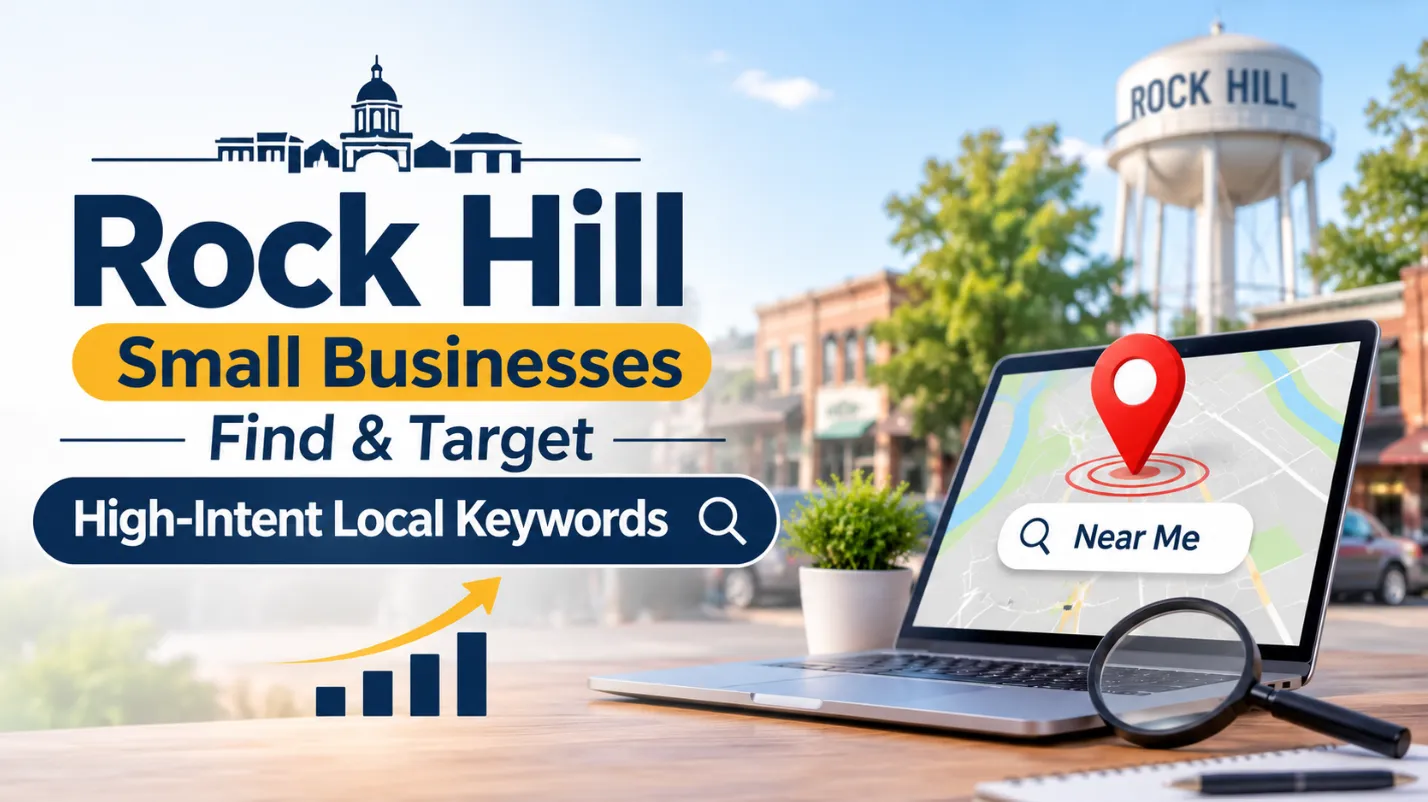

Two individuals look for assistance with their heat pump on the same day.
ONE types “how a heat pump work. The other types “heat pump repair Rock Hill SC today.
The only person with a broken system and a phone in hand. If you own a heating and cooling business that’s the person you want to find.
That’s the purpose of high-intent local keywords. They are the keywords people use when they are ready to call, book or go to a particular business at a specific location.
For a small business in South Carolina, Rock Hill that is the best use of your limited time and money. You don’t need to win every search, you need to win the ones that bring you customers.
Here’s a look at what you’ll discover inside this guide and how you can identify those keywords, select the best keywords and turn them into successful pages. It also reveals the limits of keyword research, because it provides data not guarantees.
Looking for SEO in Rock Hill, SC?
Find and target high-intent local keywords that turn searchers into calls, bookings, and paying customers.
Talk to Our SEO TeamOften, small companies go for the big number out the gate. They see a number for “plumbing” and try to capture it.
The problem is that general terms bring hordes of different people. Some searchers have a real task. Some are students. Some are merely interested. Some are in another state.
A more specific term such as water heater replacement Rock Hill will have less search volume. However, every searcher who types that term likely has a practical need and location in mind.
That phrase is achievable for a small team. And more likely to answer when you call.
Articles that are broad and generous still count. They create trust and access people who may buy from you later. But when you’re pressed for time, phrases that include the word ‘buy’ come before everything.
Typically, high intent doesn’t come from one word. It often comes from a combination of a service, a place and a signal.
Below is a list of the most frequently used signals.
| Signal | What it informs to you | Examples |
|---|---|---|
| Urgency | This need is happening right now | “urgent,” “immediate,” “anytime,” “immediate” “urgent,” “contingency,” “immediate,” “rush”...”improve,” “loss,” “pharmacy,” “mental health” |
| Location | The searcher just needs to be close to home | Please type ‘Rock Hill SC’ ‘Old Town’ ’ near me’ |
| Action | The searcher intends to employ or purchase | “repair,” “substitution,” “quote” |
| Cost | The searcher is shopping around for price | “cost,” “price,” “free quote” |
| Trust | The searching can choose who to trust | “top”, “feedback”, “authorized” |
A term containing two or three of these signals is worth noting. Some representative variations: “licensed electrician Rock Hill SC emergency”.
A term that has none for it, such as “what is a circuit breaker,” is by the book learning. It comes from another section of your plan.
One note on "near me." People type it all the time, but you rarely need to target it directly. Google already knows where the searcher is. An accurate profile and clear local pages usually cover it.
Begin with a simple list, not a tool. Sit down with the person who answers your phone and write down four items.
Now put them together. “AC not cooling Rock Hill” and “same day furnace repair Fort Mill” are actual searches a person might enter.
None of these came from the software. They came from what your customers actually talk about. Which means they’re way better than any pre-filled list.
Then, find out what search terms people are using. Free.
Enter a service and a location into Google. See the autofill options.
Keep scrolling. “People also ask” box and related searches at bottom have alternate phrases more common.
Google Business Profile InsightsYour profile performance section shows you what searches helped people to find your listing.
If you have Google Search Console connected to your site, it will display the search queries that are already bringing visitors. Some may be a little surprising.
In your business, you should be your greatest source. Reviewing your call notes, tracking emails, reading reviews and noting the questions asked at the counter.
When a customer says, “I looked for the same day AC repair and came across you,” that is a keyword in plain English. Write that down.
This is where Geekonomy, a digital marketing company that works on local search, websites and listings, usually begins with a small-business client. It gathers the phrases customers already use. Then it compares them with what the website says and sorts them by how close each one is to a purchase.
Often a short list made this way will beat the export that came from your tool.
Before you settle on a phrase, type it in on your phone. Now see what Google comes up with.
Create three questions.
What sorts of results arrive? If it’s a map and local firms, Google is assuming the searcher asked for a supplier. A provider web page has a fair possibility. If there are lengthy article content articles, the searcher is searching for info. A service webpage might not get the job done.
Who’s showing up? If you’re a national directory listing or a large chain on the first page, that phrase might be too high. If you see independent Rock Hill businesses, you have a chance.
What is on the top pages? Read two or three and observe what they are about and how well they give an answer to the question – that is the standard you have to beat.
Remember, the results vary by device and location.Your experience may be different than your customer’s experience. Use this check to guide you, not the final word.
You have a long list by now. You just don’t have the time to target all of them. Filter.
Ask 5 questions about each phrase.
| Question | Why it is important |
|---|---|
| Does the Searcher Want to Take Action? | Prepared Buyers Bring Customers, Not Window Shoppers |
| Are you genuinely providing this? | Ranking for work you don’t do wastes effort |
| Are you available to work at that location? | If you cannot be contacted visitors turn away |
| You too small to fight? | Local results without bias is a positive indication |
| Freely vs. Paid: Should a Job Be Worth Its Own Page? | Demand for high-value work requires additional effort |
Select a few that do well. “emergency plumber Rock Hill SC” and “water heater replacement Rock Hill” are a good few that a plumber could choose.
“plumbing tips” is a terrible idea. It will generate more page views. But, less calls.
Leave the teacher stuff for later. They are helpful, just not first.
A common mistake is to cover everything on the home page. Both customers and search engines prefer a page that answers one need clearly.
Create a separate page for each key service. Focus each page on a single primary intent. Having one page dedicated to “roof repair” and another to “roof replacement” provides clearer information to readers than combining both topics on a single page.
Next, match your Google Business Profile to the plan Choose your primary category carefully. Services. Hours. Link website to the service page, not necessarily the home page.
A page that matches a phrase but provides little information will quickly lose visitors. Ensure it is useful from the very first line.
Use the keyword naturally within the title, the main header and first paragraph. Then provide a direct answer to the question immediately.
A person who looks for “AC repair Rock Hill SC” is asking four questions. Yes? You do it? You are my location? How do I contact you? What do I look for?
Put those answers first. The company history doesn’t even need to be told.
Next, include information to inform users’ choice:
Prove your claims. All of them. “Licensed and insured” is not valid if it can be easily checked. “Best in the Carolinas” is nothing unless you can back it up.
End with a Q&A. Use this section to clarify items visitors asked about that you didn’t address elsewhere. Use pithy responses that are easy to scan and search tools can readily lift.
Rock Hill is located just south of the Fort Mill, Tega Cay and the greater Charlotte area. A large number of our customers live in those areas.
It can be tempting to take your page and substitute the city name. Don’t.
Almost duplicate pages leave users with minimal value. Such pages can appear as SEO trying to “trick” the ranking algorithm.
A great page for Fort Mill says something real. Maybe it talks about how fast you get there, areas you serve and any other local info that is relevant.
Don’t have anything real to say about a town? Move on. Good Rock Hill pages and a precise service area on your profile will usually be enough.
Most owners can manage the first round by themselves. It demands patience and honest assessment more than technical ability.
There are a handful of reasons why exterior assistance is appropriate:
Comparison shop an SEO company in Rock Hill, SC If you’re shopping for SEO providers in Rock Hill, SC, see how they get started. A reputable firm will ask you what you do, who you serve and what you want to achieve before providing an explanation of why they selected the keywords they did.
Before you sign, ask:
Avoid anyone who promises the number 1 position or a specific number of leads. Search results are based on things they can’t control. Honest agencies will tell you so.
Rankings are a pointer, not an outcome. Focus on what truly matters to your business:
Review Search Console and your Google Business Profile every month or two. Identify which searches attract visitors and which pages they arrive on.
If the page is ranking but you are not getting any contacts: most probable it doesn’t match the search intent. Rephrase the content. If the page has few visits but is converting nicely: it might need some extra push.
Allow changes to take hold. New pages and editing can take weeks, months to settle in. Results depend on competition and season. Make multiple changes so you can see what effect each is having.
Lastly, be realistic. Good keyword targeting ensures the right customers are directed towards you. It cannot compensate for a bad offer, slow response times or negative reputation. It’s most effective if a business is already providing a good service to customers.
What are high-intent local keywords? A search phrase that indicates the searcher is willing to make a decision about a local business. An example is “emergency plumber Rock Hill SC” or “same day handyman Union County SC.” These keywords tend to include a service, a place and a letter of intent (sign of readiness) like cost, open now.
Google’s auto-complete, people also ask box and related searches. Search terms on your Google Business Profile and Search Console. Words used by customers in phone calls, reviews and emails. Use these words along with your products and the places you serve to come up with a realistic initial set.
Start with a small number, typically the most valuable few services with each its own page. Expand upon them once those pages have been established. Don’t sacrifice quality for quantity; since every page should have one unifying intent and be kept accurate.
Understanding what high-intent local keywords you need to target is largely a matter of listening. First, listen to your customers Second, listen to how people search Third, see what Google already shows up for those searches.
Begin with a quick list based on genuine questions. Use the terms that are nearest to a sale. Give each one its own page that deals with it sincerely. See what you get.
If a Rock Hill business does this consistently, it does not have to spend more money than anyone else. It only has to be the best answer to the question the customer is asking.
Ready to Target High-Intent Keywords in Rock Hill?
Geekonomy helps Rock Hill, SC small businesses identify, target, and rank for the exact local searches that generate calls and revenue.
Talk to Our SEO TeamAbout the Author :

SEO STRATEGIST
An SEO Strategist At Geekonomy Specializing In Semantic SEO, Technical Audits, And Search-Focused Content Strategy. He Helps Businesses Across The USA, UK, And India Improve Search Rankings, Grow Organic Traffic, And Generate Qualified Leads Through Structured, Data-Driven SEO Frameworks.
His Strategies Have Helped Brands Achieve Up To 3X Organic Traffic Growth And Secure Top-Page Rankings For Competitive Keywords. At Geekonomy, Rahul Shares Actionable Insights On SEO Trends, Search Algorithms, And Performance-Driven Digital Marketing Strategies Designed For Global Markets.