Curating reads
Gathering fresh stories and ideas for you
Curating reads
Gathering fresh stories and ideas for you
Curating reads
Gathering fresh stories and ideas for you
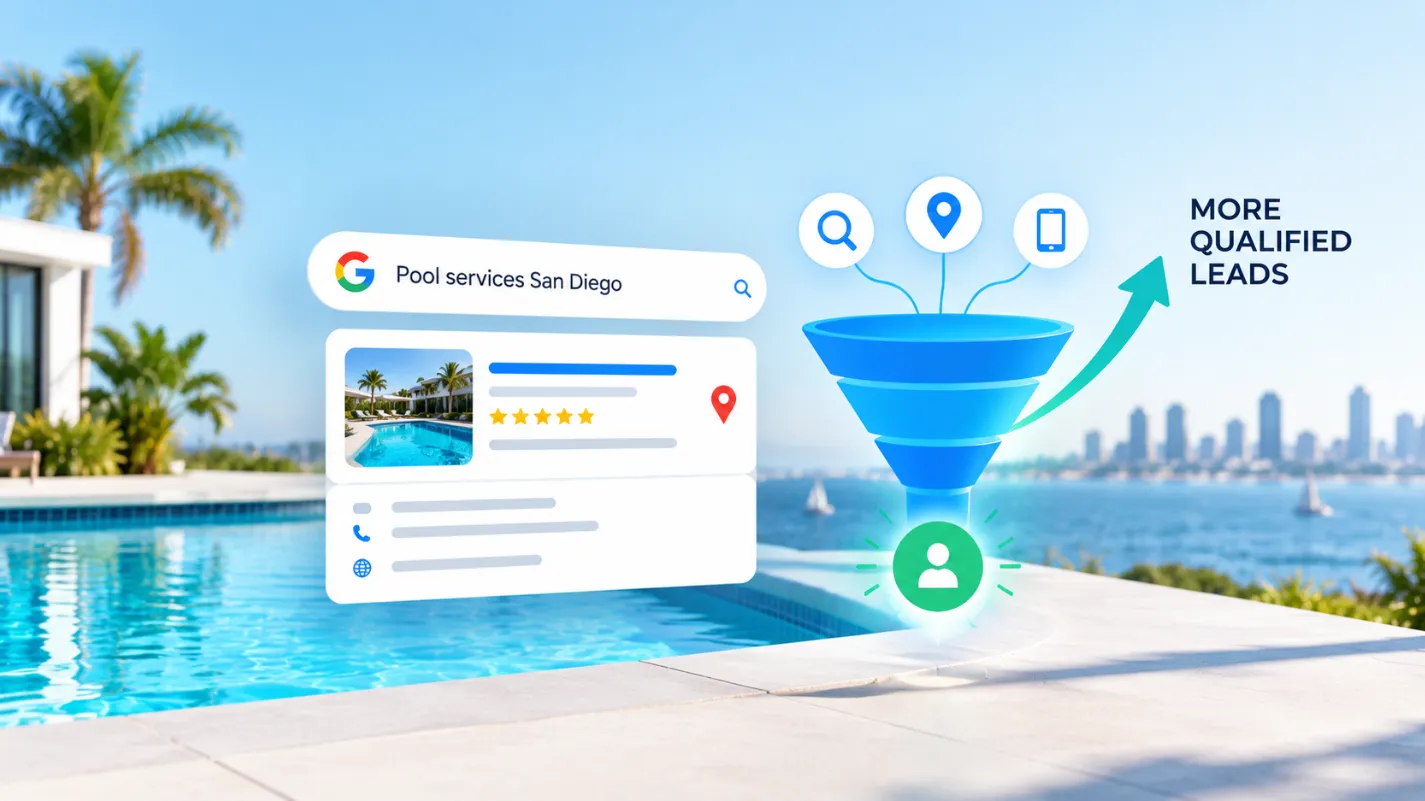

Operating a Pool Business in San Diego is Easy San Diego’s climate offers year-round swimming, homes sell better with a pool and upgrades, and every community from La Jolla to Chula Vista has a healthy supply of new construction, aging pools in need of repairs, and folks who need a dependable pair of hands to get the water Sparkling.
It’s also a competitive space. A search for “pool builder near me” from a homeowner in Encinitas will return a hefty list of companies and more times than not, many of them appear to be pretty similar at first blush. The companies who are actually successful aren’t always the ones with the largest ad spend. They’re the ones showing up in the right spots, saying the right things and making it easy for a motivated homeowner to call.
Here’s what it looks like in action. You will learn what the actual qualified lead looks like, where homeowners go for pool-related assistance in San Diego, and how to establish a marketing machine that receives those perfect inquiries. If you are interested in hiring a team for the labor, check out our digital marketing for pool companies in San Diego page.
Looking to Get More Pool Leads in San Diego?
Attract qualified homeowners, improve your local visibility on Google, and convert clicks into booked projects with data-driven marketing.
Get Your Free Pool Marketing StrategyA lead is anyone who reaches out to you, a qualified lead is a person who needs your service, and has the resources to pay for it. This matters, because many pool companies count every call they get as a lead, then wonder why their salespeople are exhausted and sales aren’t increasing.
A qualified pool lead is usually in your service area, wants the service you actually sell, has a feasible budget, and has a timeline. They also own the property, since renters rarely approve a remodel. Homeowners in Escondido are a good fit for a North County builder, while a request from Temecula may not be. Someone asking about weekly cleaning is not a fit for a company that only builds custom pools. And ‘we’re ready to start this spring’ is a much stronger signal than ‘just looking at ideas.’
Create marketing from your defined traits Once you have these traits, create marketing around them. Write your website copy, your ads and your lead forms to attract the right people, and politely reject the rest.
Get to know the way your buyers search. The majority of homeowners tend to have a certain process, even though they may not even know it.
At any point along this journey, you have a choice to be visible or to be invisible. Even a poor Google Business Profile, a sluggish website, or a service page that says next-to-nothing about your work could cause you to miss out on a lead without even realizing it.
Your website is where interest becomes a discussion. There are plenty of pool company websites that look attractive but not much is done to help the visitor make a decision.
A single “Services” page with only a brief list is insufficient. Both search engines and homeowners favor having a separate page for each main service, such as custom pool construction, remodeling and resurfacing, weekly cleaning and maintenance, equipment repair and replacement, and spa or water feature installation. Each page should describe who the service is intended for, outline the process, note what influences pricing, give typical timeframes, and specify the service areas. Using actual photos from San Diego projects is preferable to stock images.
Never make a visitor who wants to talk find a button or a link to do so. On every page, have a visual call button and a quick quote form. Make the form short: Name, phone, address or neighborhood, and a line about the project is all you usually need. Long forms will kill your response rate.
Most homeowners will actually search from their phones – often standing out in the yard staring at the pool. If your site loads slow, or feels wonky on a small screen, they’ll return to the results and choose someone else. Compress your images, don’t use too many sliders, and try it out on your own phone!
The biggest obstacle in pool work is trust. However, it’s too costly and inconvenient. Put proof where they’ll see it. Make your contractor license number obvious, along with your insurance and bonding info. Include pictures of completed work, identified by neighborhood, quick testimonials by first name and neighborhood, and clear warranty specifications.
If you run a service business in a specific geographic area then local search is likely the consistent lead generator for you. If someone needs a pool company, they want someone close. And Google’s got it.
Your Google Business Profile is the card that shows up in map results. Think of it as a second website. Select the best primary category such as “Swimming pool contractor” or “Swimming pool repair service” and include all other relevant secondary categories. Include all the services you provide with a short description and accurately set your service areas. Do not include cities in your service areas where you do not provide service. Make sure your hours and phone number are accurate including holiday hours, post fresh photos frequently, and respond to all questions and reviews.
Use consistent name, address and phone number Your business should have the same name, address and phone number on your website, on Google, on Yelp, Facebook, and all directories. Slight inconsistencies, such as “Ste” in one place and “Suite” in another, can be confusing to search engines. Review your main listings once or twice per year.
If you serve multiple areas, create pages that address each one with meaningful content. For example, a page for La Jolla could discuss typical pool styles in the area, local permit requirements, and showcase examples of your nearby projects. Do not simply duplicate a page and change the city name. Both search engines and homeowners can recognize this.
Reviews affect both rankings and customer choices. Request feedback from each satisfied customer, preferably within one or two days of completing the work, while the experience is still recent. Sending a straightforward text message with a direct link to leave a review is effective. Reply to every review in a courteous and specific manner, including the rare negative one. A composed, constructive response to criticism can reassure future customers even more than a flawless rating.
A blog or resource area can attract homeowners sooner in the decision, prior to them choosing a company. We want to be the source they go to learn from.
Some popular topic ideas for pool companies in San Diego are: How much does a pool cost in San Diego County? What is the process for getting a pool permit and inspection? How do I choose between a plaster, pebble and tile finish? Other helpful topics include: How can I reduce my water use and energy costs? How can I tell if my equipment needs repairs? How often should I service my pool?
Write what you encounter out in the field. Reference actual circumstances you work within: sloped land in the hills, sandy dirt by the coast, tiny backyards in densely developed neighborhoods. Real-life detail like this is what distinguishes useful content from empty filler, and it gives the reader confidence that a legitimate person who really knows what they’re doing is writing this page.
Google makes an overall content assessment based on experience, expertise, authoritativeness and trust (E-E-A-T, for short). E-E-A-T isn’t a test score, but it tells us what quality reviewers look for, and resonates with what a nervous homeowner needs to see before writing a check for a significant sum.
| Quality signal | What it means to a pool company | How to present it |
|---|---|---|
| Experience | This is what you have worked in actual yards | Project Photos, Job notes, Before & after stories |
| Expertise | You’ve got the technical side handled. | Articles written and/or reviewed by your builders and technicians |
| Authoritativeness | Others have recognized your work | Consumer reviews, local press, industry associations, certifications by suppliers |
| Trust | You are honest and verifiable | License number, Insurance, Clear guidance on pricing, Real Address, Contact Details |
In actual fact, this involves including an author name and brief biography with each article, including your role in the pool trade and number of years. Have an About page with the owner and important personnel, with photos. List your license and insurance on the site, share your pricing philosophy honestly, even if you can’t give specific prices, and update older articles when codes, materials and costs shift.
If you can afford it, search ads help cover what you’re missing until your rankings take off and are particularly effective during the spring rush when volume spikes.
Identify high intent searches – people who need to hire, like “pool remodel San Diego”, or “pool repair near me”. Set your location targeting to your actual service area. Use negative keywords to exclude searches that are wasting your money, like “DIY”, “jobs”, “free” or “above ground pool”, if you don’t do them.
Send every ad to a relevant page of your site. If you’re advertising pool resurfacing, send the person to the resurfacing page not the homepage of your website.
In your trade, where eligible, Google Local Services Ads show your business first in results with a “Google Guaranteed” or similar badge, and cost per lead not per click. They can generate phone calls from people who are eager to call. Review the latest eligibility criteria for your category; they are subject to change.
Facebook and Instagram are great for visual content. By showing a completed job of a backyard renovation to homeowners within a specific zip code, you can begin a conversation long before they start their search. These leads tend to be further back in the process, so have a plan to follow up.
Cost per click and cost per lead are visible metrics but do not provide the full picture. The important figures are the cost per qualified lead and the cost per closed job. If one channel generates fewer calls but results in more signed contracts, that channel is more effective.
Pool work is visual, and that’s a strength. A standout project shot is worth a thousand words. Share completed project images on Facebook and Instagram, naming the area, type of job, and neighborhood. A quick clip of a project in process – excavation, plumbing, plaster – offers a glimpse of your work; a before-and-after image of a pool or remodel will make an instant impression. Share a team photo too: People want to know who will be working in their yard.
Republish this content on your website and your Google Business Profile so this work doubles up.
Many requests do not result in a sale simply because there is no follow through. A homeowner looking for an estimate will often be trying to reach four different companies, and if you are quick to respond and answer clearly, you might be the one to get it.
Here’s a common simple follow-up:
Email also is effective for existing customers for asking for a referral, for maintenance reminders and for existing customer offers on equipment upgrades. Former customers can be your best source for new work.
You cannot improve what you do not measure. Minimum measurement will be as listed:
| Metric | Why it is important |
|---|---|
| Calls & form submissions by source | Indicates the channels with contact. |
| Qualified leads categorized by source | Sorts beneficial questions from the distractions |
| Cost per qualified lead | Enables you to set realistic budgets |
| Close rate | Indicates the effectiveness of sales conversion rate |
| Channel wise revenue | Links marketing to dollars |
| Number of reviews and rating average | Builds reputation over time |
Set up Google Analytics and call tracking so that each phone call can be traced back to where it came from. Review the numbers monthly and make small changes based on what you see. Marketing for local service businesses usually improves through steady adjustment, not one big launch.
The majority of lost leads can be attributed to repeat mistakes.
Chasing phone traffic, not leads. A full phone line sounds lively, but price shoppers and out-of-area demand only add to your sales reps’ workload. Focus on fewer, more targeted leads.
Ignoring your Google Business Profile. The free profile can generate more calls than your website every month. Lacking services, outdated images and no response to reviews all make a competitor look more busy.
Using information pages. If a page continues to function after a fresh, rival name has been added, it is simply too generic. Provide tangible evidence of your contribution, your field and your methodology.
Slow replies. Homeowners call multiple businesses to get rates, and whoever provides an obvious answer early on usually wins.
No tracking. No call tracking, no monthly review makes any budget decision a hunch.
Hiding the pricing and the process. You don’t need a rate card but giving a big ballpark and a step-by-step process will help buyers have confidence in you.
One of these alone can up your lead quality in a matter of a week or so.
Not sure how to start? This order is effective for most pool companies in San Diego:
Once past the 90 day marker you will have something to build upon and actual data on what quality leads.
Paid search ads can generate inquiries as soon as you turn them on. Local SEO can take three to six months to really start working as your rankings and calls grow over time based on how competitive your area is and how much work your profile and website require. Most businesses achieve optimal results while ads are short-term and SEO is more long-term.
Set a Budget How much you spend will depend on the size of your business, the kind of business you run and what you’re trying to accomplish. Many local service businesses have a marketing budget based on a percentage of revenue and then tweak it based on their lifetime customer acquisition cost and lead-to-sale ratio. A good rule of thumb is to invest a small budget in the most likely to succeed channels and monitor for a few months before investing more in the proven channels.
Qualified leads come from being easy to find, easy to trust, and easy to contact. For a San Diego pool company, that means having a clear and fast website, a strong local presence on Google, honest content based on real work, reviews from happy customers, and a follow-up routine that ensures good inquiries are not missed.
None of this has to happen all at once. Take it step by step, monitor what results you see, and then optimize each step. If you’d like to learn about building or managing a system like this, you can find out about our pool company digital marketing services in San Diego and contact the Geekonomy team.
Ready to Scale Your San Diego Pool Company?
Geekonomy helps pool builders, remodelers, and service contractors in San Diego generate more qualified leads, rank higher on Google Maps, and win high-value projects.
Get Your Free Pool Marketing StrategyAbout the Author :

SEO STRATEGIST
An SEO Strategist At Geekonomy Specializing In Semantic SEO, Technical Audits, And Search-Focused Content Strategy. He Helps Businesses Across The USA, UK, And India Improve Search Rankings, Grow Organic Traffic, And Generate Qualified Leads Through Structured, Data-Driven SEO Frameworks.
His Strategies Have Helped Brands Achieve Up To 3X Organic Traffic Growth And Secure Top-Page Rankings For Competitive Keywords. At Geekonomy, Rahul Shares Actionable Insights On SEO Trends, Search Algorithms, And Performance-Driven Digital Marketing Strategies Designed For Global Markets.